
Toxic Traits of Media Platforms: Unmasking the Shadows of Algorithmic Culture
By Modesty Chang
Diversity & Wellbeing Subcommittee Member
Ever noticed how those quick, catchy TikTok videos seem to hook you in, one after another? "Share controversial opinions," they say. It's a tactic that gets clicks and keeps people engaged, but at what cost? Lies, scapegoating, over-exaggeration, and unrealistic standards bombard our mental health in 15-second bursts. And the worst part? Most of us don't even realize how we're being pulled into this consumerist vortex.
This phenomenon is a direct result of algorithmic culture — where algorithms dictate what we see based on what gets the most likes, shares, and views. Social media managers have become masters at playing this game, crafting posts that maximize engagement. The higher the engagement, the more likely the content gets pushed to a wider audience.[1]
But here's the catch: this system creates echo chambers. You end up seeing only what aligns with your existing beliefs, reinforcing your views without exposing you to diverse perspectives.[2] It's like living in a bubble where the same ideas bounce around, making it hard to see beyond your own little world.
The Misinformation Minefield
One of the nastiest side effects of algorithmic culture is the spread of misinformation. Algorithms prioritise content that grabs attention, even if it's not true. Remember that viral video by a YouTuber showing how fake celebrity news can be easily created and spread?[3] (Just in case you are wondering – the main character was Harry Styles – go check the video out!) It went viral for all the wrong reasons, highlighting how even reputable news platforms can get duped. They, too, fall into the trap of prioritising clicks and views over accuracy.

GeorgeMason TV. (2022). How I tricked the internet into thinking I was Harry Styles... https://www.youtube.com/watch?v=NhYCKep-yas&t=379s
This shows the profit-driven motives of tech companies. They control these algorithms to shape cultural narratives to their advantage, all while keeping the workings of these algorithms a secret.[4] This lack of transparency makes it hard to hold them accountable, creating a commercial black box that shields them from scrutiny.[5]
Moving Forward: The Path to Digital Literacy and the Online Safety Act 2021
So, what can we do about it? Promoting digital literacy is a start. We need to think critically about the content we consume. Be aware of the biases and values these algorithms might be embedding in what you see and hear.[6]
Enter the Online Safety Act 2021,[7] a game-changer in addressing the toxic traits of media platforms. This legislation holds tech companies accountable for the content they host, focusing on user safety and reducing harm. It pushes for transparency in how algorithms work and requires better content moderation. With these rules, platforms must take responsibility for curbing misinformation and breaking the cycle of echo chambers. By enforcing these standards, the act helps ensure that our digital world prioritizes truth and user well-being over mere clicks and profits.
In the end, while algorithms can enhance our online experiences, we must be vigilant about their potential to distort reality and manipulate our perceptions. By fostering digital literacy and demanding greater transparency, we can strive for a digital environment that values truth and fairness over clicks and profits.
[1] Metzler, H., & Garcia, D. (2023). Social Drivers and Algorithmic Mechanisms on Digital Media. Perspectives on Psychological Science. https://doi.org/10.1177/17456916231185057
[2] Talamanca, G & Arfini, S. (2022). Through the Newsfeed Glass: Rethinking Filter Bubbles and Echo Chambers. National Library of Medicine.
[3] GeorgeMason TV. (2022). How I tricked the internet into thinking I was Harry Styles... https://www.youtube.com/watch?v=NhYCKep-yas&t=379s
[4] Kopelman, S., & Frosh, P. (2023). The “algorithmic as if”: Computational resurrection and the animation of the dead in Deep Nostalgia. New Media & Society. https://doi.org/10.1177/14614448231210268
[5] Hristova, S et al. (2022). Algorithmic Culture: How Big Data and Artificial Intelligence are Transforming Everyday Life. New York Lanham.
[6] Tsamados, A; Aggarwal, N; Cowls, J et al. (2021). The ethics of algorithms: key problems and solutions. AI & Soc. https://doi.org/10.1007/s00146-021-01154-8
[7] Online Safety Act 2021 (Cth).
Let's Talk Stress: Five Tips in Keeping Physically and Mentally Fit!
By Libby Wilkins
Diversity & Wellbeing Subcommittee Member
“It’s a marathon, not a sprint.”
We’ve all heard it. This ‘well-utilised’ statement is typically offered by our superiors to remind us to pace ourselves in our study habits, particularly in the early days when we’re finding our feet.
While many of us would agree that ‘sprinting’ early on in our studies can result in heightened fatigue, a sense of overwhelm, and loss of motivation (i.e., burnout!)[1], running a ‘marathon’ isn’t any ‘walk in the park’.
So, how do we go about this? How can we make our law journey more maintainable on this long and arduous path?
The answer… maintaining our physical and mental wellbeing!
This is probably another piece of advice you’ve heard before… but it actually holds significant weight (stay with me here)! Australian and International data has found that there is a clear correlation between poor self-care and heightened psychological distress amongst uni students.[2] So, keeping a fit and healthy body must promote improved mental health.
Let’s get physical and strive for better mental and physiological fitness. Here are my top five self-care tips:
(1) Get Moving
As cliché as it is, staying physically active is the key to optimal self-wellbeing. It doesn’t need to be a pumping HIIT workout. It can be as simple as going on a brisk 30-minute walk. Personally, I find that getting up bright and early each day for an hour-long walk is idyllic. Walking in the morning sun helps improve brain health and gives you that natural boost of energy.[3] Plus, a regular walking routine can help set your natural circadian rhythm (that is, setting a sleep pattern). [4]
(2) Socialise
Having our own space is important (trust me, as a secret introvert I get it). But, staying connected and communicating with other people is also essential in maintaining mental wellness. Staying connected doesn’t require you to do anything grand. It can be as simple as grabbing a coffee with a friend, giving your relatives a call, or even going along to one of the UQLS’ many social events. Start making those connections NOW!
(3) Eating well (and eating good)
While we all know that maintaining a nutritious diet is key to optimal physical health, enjoying your favourite foods is also important. I find that the 80/20 method is perfect in staying physically fit, whilst also giving myself the opportunity to splurge on my favourite treats. With ANZAC Day just past, try out my spin on the Day’s classic – chewy ANZAC biscuits with choc-chips. PSA – for my international friends, ANZAC Day is where Australian and New Zealanders commemorate our fallen servicemen and recognise our armed forces. Try them out!

(4) Sleep
I cannot stress this enough. Sleep should definitely be up on your priority list. Whilst getting good sleep won’t necessarily give you more ‘awake’ time, it does give you far better use of the ‘awake’ time that you actually have.[5] I recommend going to bed at a reasonable hour (no later than 10pm), setting a consistent sleep schedule (hint: go on an early morning walk – see Tip 1!), and be firm with your priorities – your seminar prep can certainly wait until the morning.
(5) Breathe
Sit straight. Close your eyes and start focussing on your breathing. Feel the air come in through your nose and out through your mouth. Inhale for 4 seconds through your nose, feeling your ribs expand. Hold for 7 seconds. Then exhale out through your mouth for 8. Repeat 10 times.
Doing this simple exercise just once a day can make a world of difference. It might sound silly, but observing your breathing can relieve stress and open your body to a more mindful lifestyle.[6]
We all share the same one goal – we want to get through law school. Let’s get through this ‘marathon’ the best way we can.
You’ve got this!
[1] ‘How Much Studying Is Too Much: Effects Of Overstudying & How To Prevent It’, Scholars (Web Page, 24 January 2024) <https://www.scholarsed.com/effects-of-overstudying/>.
[2] Vivienne Browne, Jonathan Munro, Jeremy Cass, ‘The Mental Health of Australian University Students’ (2005) 50 Journal of the Australian and New Zealand Student Services Association 51, 51.
[3] ‘9 health benefits of a morning walk’, IRT (Web Page, 20 July 2022) < https://www.irt.org.au/the-good-life/9-health-benefits-of-a-morning-walk/>.
[4] Ibid.
[5] Andrew Ayers, ‘Prioritize Sleep: A Good Way To Make Sure You Stay Healthy’, Andrew M Ayers (Web Page) <https://www.andrewmayers.com/blog/prioritize-sleep-a-good-way-to-make-sure-you-stay-healthy-.cfm#:~:text=As%20they%20point%20out%2C%20%E2%80%9CGetting,to%20blue%20light%20at%20night>.
[6] ‘Breath meditation: A great way to relieve stress’, Harvard Health Publishing (Web Page, 15 April 2014) <https://www.health.harvard.edu/mind-and-mood/breath-meditation-a-great-way-to-relieve-stress>.

Embracing Diversity in Law: Reflections from the UQLS Diversity in Law Evening
It was a lively evening at the Banco Courts last Wednesday, filled with legal professionals, students, and advocates, all gathered for the University of Queensland Law Society Inc (UQLS)'s fourth annual Diversity in Law Evening. This event, a highlight in the UQLS’s calendar, featured an esteemed panel to delve into the importance of diversity and inclusion in the legal profession. Five distinguished legal professionals featured on the panel: Tilé Imo from Caxton Legal Centre as the Master of Ceremonies, Olamide Kowalik of Revolution Law, Luke Furness of Clayton Utz, Professor Paul Harpur OAM from The University of Queensland, and Claire Brattey from Corrs Chambers Westgarth. Attendees were left with valuable takeaways from each panellist's unique experiences, fuelling a vibrant conversation about the ongoing journey toward a more diverse, equitable, and inclusive legal community.
By Shanice Timotius
UQLS Diversity & Wellbeing Subcommittee Member

It was a lively evening at the Banco Courts last Wednesday, filled with legal professionals, students, and advocates, all gathered for the University of Queensland Law Society Inc (UQLS)'s fourth annual Diversity in Law Evening. This event — a highlight in the UQLS’s calendar — featured an esteemed panel to delve into the importance of diversity and inclusion in the legal profession. Five distinguished legal professionals featured on the panel: Tilé Imo from Caxton Legal Centre as the Master of Ceremonies; Olamide Kowalik of Revolution Law; Luke Furness of Clayton Utz; Professor Paul Harpur OAM from The University of Queensland; and, Claire Brattey from Corrs Chambers Westgarth. Attendees were left with valuable takeaways from each panellist's unique experiences, fuelling a vibrant conversation about the ongoing journey toward a more diverse, equitable, and inclusive legal community.
Mastering Resilience and Overcoming Adversity with Determination
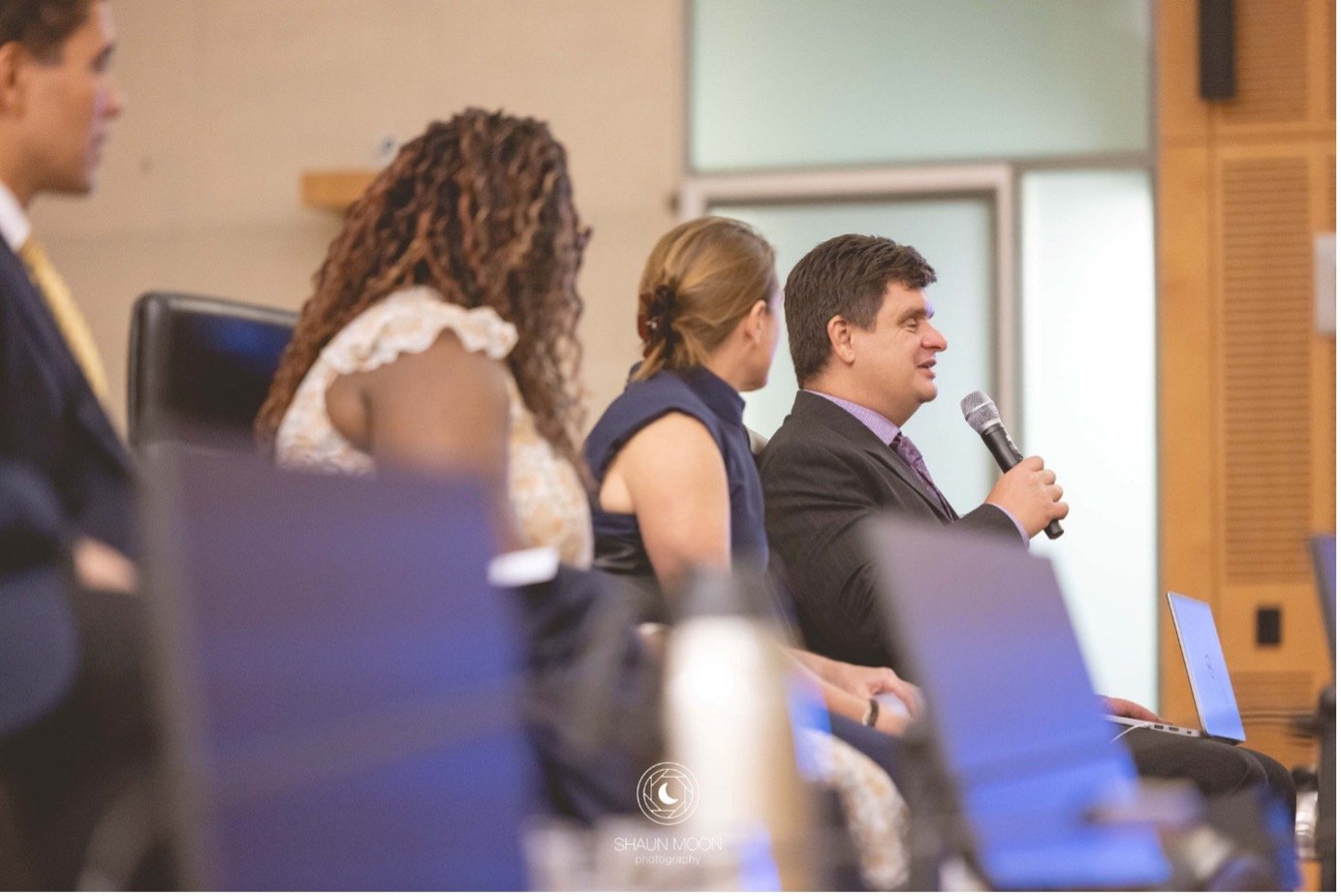
Professor Paul Harpur oam speaking at the uqls diversity in law evening
Professor Paul Harpur OAM has navigated a path with challenges as a visually impaired academic to become a beacon for disability rights. After losing his vision in a train accident, Paul's life changed overnight.
Since then, Paul has learned to master the art of thriving amidst adversity, embracing adaptability with the motto "things happen, move on”.
With accolades such as the Order of Australia Medal and being crowned the 2022 Blind Australian of the Year, his contributions to disability advocacy are both celebrated and inspiring. As an esteemed associate with the Harvard Law School Project on Disability and an International Distinguished Fellow with the Burton Blatt Institute at Syracuse University, New York, Paul’s name resonates globally as a legal scholar and advocate par excellence.
Despite all his achievements, Paul remains grounded. He acknowledges his strong support network that has anchored him, and his high-quality education that has propelled him forward. He is dedicated to advancing human rights and continues to work towards his vision by empowering universities to champion disability inclusion.
The Power of Perseverance through Hard Work, Support Systems, and Developing a Robust ‘Legal Toolkit’

olamide ‘olly’ kowalik speaking at the uqls diversity in law evening
Olamide ‘Olly’ Kowalik's journey from Nigeria to Australia as an international student exemplifies the power of perseverance. Despite facing limited opportunities for international students in securing graduate jobs, Olly’s resilience led her to find a mentor who believed in her potential and furthered her development. Today, she is a senior lawyer at Revolution Law and recognized by Doyles as one of Queensland's Leading Medical Negligence Lawyers. Olly attributes her success to her diverse “legal toolkit” and a strong work ethic, emphasizing that "there is no substitute for hard work".
At 28, Olly’s journey took a new turn when she became a mother, adding a new layer to balancing work-life balance. With support from her husband and workplace, she navigated this transition, proving that what can be perceived as a challenge can be a superpower with the right support system. Olly’s story is a testament to the importance of building a ‘village’ – be it family, colleagues, or mentors - to lean on for support.
As a junior lawyer, Olly recognised the underrepresentation of diverse voices in the legal community. Seventeen years later, when the opportunity arose, she seized the chance to co-host the 'Tilé and Olly Meets' podcast with fellow lawyer Tilé Imo. The podcast aims to spotlight the multifaceted nature of diversity in the legal community, offering a platform for underrepresented voices.
“Diversity, as we all know, is not just one thing and can intersect across gender, culture, race and ethnicity, religion, disability, and sexuality, to name a few.”
Olly paying it forward extends to her mentorship, as she now mentors young lawyers. Olly leads her life, personally and professionally, by consistently exemplifying resilience, determination, and a whole lot of heart.
Advocating for Change and Leading the Charge for Diversity and Inclusion

luke furness speaking at the uqls diversity in law evening
Luke Furness, a lawyer and advocate for diversity and inclusion, has consistently used his voice to champion change within the legal profession. As a Special Counsel in the Commercial Litigation team at Clayton Utz, Luke emphasised the importance of open communication to gain support in the workplace, particularly from leadership. In pursuit of his passion for advocacy, Luke has also chosen to undertake a secondment, working one day a week at the Institute of Urban Indigenous Health (IUIH) Community Legal Centre.
Luke's commitment to promoting diversity doesn’t stop there. As the former CEO of Out For Australia – a national LGBTIQ+ student mentoring not-for-profit organisation – Luke continues to share his insights on diversity and inclusion through various platforms, including ABC Radio and the Australian Financial Review. Additionally, Luke serves as a board member for both the Brisbane Powerhouse and Effective Altruism Australia, where he continues to advocate for positive societal impact.
Luke’s holistic approach in balancing family and community commitments with work reflects a broader shift in priorities that many professionals may feel pressured to compromise on. In today’s fast-paced legal world, Luke exemplifies that compromise and balance between one’s personal and professional lives are key to excelling – not a hinderance. For law students feeling the pressure of mapping out their careers, Luke offered some sage advice:
“You’re all smart people, and it doesn’t matter where you start because you’ll have a long career and your needs and wants will change.”
Luke’s words are a reminder that the journey is as important as the destination. Law is a marathon, after all, not a sprint. As a mentor and advocate, Luke continues to inspire and encourage a more inclusive legal community.
Redefining Advocacy by Subverting Expectations

claire brattey speaking at the uqls diversity in law evening
Claire Brattey has skilfully navigated her way through the legal landscapes of the UK and Australia, achieving remarkable success despite being thousands of miles away from her homeland in Scotland. Having spent over a decade as an employment lawyer in the UK, Claire's move to Australia was not without its hurdles. Despite speaking the same language, even subtle differences in mannerisms and slang created unexpected communicative barriers.
Claire tackled this challenge by blending her Scottish communication style with Australian English, effectively gubbing the cultural gap (a Scottish term she humorously introduced to her colleagues).
Despite Claire’s constructive approach, she has been repeatedly underestimated due to her foreign background. Instead of seeing this as a setback, however, Claire leveraged these experiences into opportunities to demonstrate her strong advocacy skills.
Now, as Special Counsel in the Employment and Labour team at Corrs Chambers Westgarth, Claire leverages her extensive experience to champion diversity and inclusion in the workplace. Claire's advocacy goes beyond legal representation; in her practice areas, she aims to empower individuals at all stages of their careers, emphasising that a diverse and inclusive environment is not just beneficial but essential for a vibrant legal community.
Until Next Year
As the evening drew to a close, the Banco Courts buzzed with a renewed sense of purpose and inspiration. The panellists, through their stories and insights, painted a vivid picture of the challenges and triumphs on the path to a more inclusive legal profession. It served a reminder that diversity isn't just a buzzword: it is a cornerstone of justice and equity.
Tilé Imo's words resonated long after the event:
“Diversity is a fact of life – we cannot escape it whether in our workplaces, through politics, or with the clients and community we serve. What I took away from the panel is that there are still nuances when it comes to understanding diversity, as a framework, as an approach, and as a systemic challenge that the legal profession has an important role in steering for advancing access to justice, equity, and empowerment.”

Tilé Imo speaking at the uqls diversity in law evening
The UQLS extends a special thanks to Corrs Chambers Westgarth, whose support was pivotal in celebrating the richness that diversity brings to the law and acknowledging that varied backgrounds, experiences, and perspectives strengthen our collective ability to advocate for justice.
As we look forward to next year's Diversity in Law Evening, it is clear that the journey toward diversity and inclusion in law is not just ongoing; it is vital to the profession’s continued success.

5 People with Law Degrees Who Have Taken or Created an Unconventional Path
by Imogen Price
UQLS Diversity & Wellbeing Subcommittee Member
1. Mahatma Gandhi – independence leader and activist

Indian Independence and spiritual leader, Gandhi, continues to inspire peaceful resistance and religious tolerance as a renowned advocate of non-violent protest. After studying Law in London and attempting to practice in India, Gandhi developed his early activist skills in South Africa where he lived for over 20 years.[1] Gaining the title Mahatma, ‘great soul’, and having his birthday celebrated as the International Day of Non-Violence, Gandhi’s legal work in South Africa, political works with the Indian National Congress and simultaneous activism is an exemplary model for using your legal studies to impart meaningful change. His expectations of the legal systems and their consequential shortcomings led Gandhi to a life of peaceful civil disobedience, “an expression of one’s highest respect for the law.”[2]
2. Rebel Wilson – writer, producer and actress

For Wilson, she knew she wanted to be on the big screen, but in such a competitive and volatile industry, she had to have a fallback – that was her Arts/Law degree. Despite the obscene 4am-9:30pm days she spent at uni whilst balancing her TV career, Wilson was determined to finish her degree. Her legal skills have proved invaluable in her dealings with film industry being the first Australian Actor to maintain the intellectual property rights to her characters on an SBS show, conducting the DVD distribution of her first TV show, dealing with her own contracts and winning arbitration matters on movie classifications.[3] Without her law degree, Wilson’s acting career could have looked vastly different.
3. Mario Ancic – tennis player

Once world no.7 forced into retirement due to the implications of his battle with mononucleosis, now finance lawyer.[4] Ancic was heading towards his career peak before injury ended his tennis career and began his legal career, initially at the University of Split, Croatia, and later at Columbia University. Merging his two paths, Ancic wrote his thesis on the organisation of the ATP Tour and researched doping in professional tennis at Harvard.[5] Ancic now works in private equity law in New York City, entirely reinventing himself in the law beyond his sporting background.
4. Nelson Mandela – activist and politician

South Africa’s first democratically elected President studied initially at the University of South Africa Law School and is remembered as one of the most influential activists in history. Mandela was awarded the Nobel Peace Prize for his anti-apartheid work after spending 27 years in prison for his advocacy against, and resistance to the National Party of South Africa and their enforcement of racial segregation.[6] By using his law degree to combine human rights and politics, Mandela was a force for meaningful change.
5. Annabell Crabb – journalist and author

Political Journalist, Annabel Crabb, is one of Australia’s most recognisable TV and news personalities who has covered Australian politics for over 25 years. Training to be a journalist after studying law but never practicing, Crabb employed her legal knowledge of the government and our democratic systems to commentate on numerous elections, the inner workings of parliament, party relations and gender in the public sphere among other things.[7] She remains a key political personality in Australian media.
Sources
[1] “Mohandas Karamchand Gandhi.” All Voices of Partition people, British Library. Accessed 16 Oct 2023.
[2] DiSalvo, Charles R.. “M. K. Gandhi, Attorney at Law: The Man Before the Mahatma”. University of California Press, 2013. ProQuest Ebook Central, <https://ebookcentral.proquest.com/lib/uql/detail.action?docID=1375716>.
[3] “Exam rituals, sleeping in the library, and countless parking tickets: Rebel Wilson reflects on her time at UNSW.” UNSW Alumni & Giving – News, < https://www.alumni.giving.unsw.edu.au/news-events/news/exam-rituals-sleeping-library-and-countless-parking-tickets-rebel-wilson-reflects>.
[4] Sinha, Smriti. “From the tennis court to the court of law: Mario Ancic's new career.” Sports Illustrated, 15 Aug 2014, <https://www.si.com/tennis/2014/08/15/mario-ancic-columbia-law-student>.
[5] Lattman, Peter. “Former Tennis Star Makes a Mark at Columbia Law School.” The New York Times, 7 Sep 2012, <https://archive.nytimes.com/dealbook.nytimes.com/2012/09/07/former-tennis-star-makes-a-mark-at-columbia-law-school/>.
[6] “Nelson Mandela – Biographical”. NobelPrize.org, Nobel Prize Outreach AB 2023. 15 Oct 2023, <https://www.nobelprize.org/prizes/peace/1993/mandela/biographical/>.
[7] “Annabel Crabb starts with 'The Advertiser' in Adelaide to cook up stylish commentary on Australian politics.” Adelaide AZ, <https://adelaideaz.com/articles/annabel-crabb-goes-from--the-advertiser--in-adelaide-to-cook-up-commentary-of-australian-politics-with-style>.
The Diversity & Wellbeing Blog is run by the UQLS as a way to keep members informed and aware of the legal profession beyond the walls of the Walter Harrison Law Library.
The main blog contributors are Diversity & Wellbeing Subcommittee members.