
“Different legal systems, same story”: A Short Analysis of How Many More Women? by Jennifer Robinson and Keina Yoshida
By Phoebe Smith
UQLS Diversity & Wellbeing Subcommittee Member

“Different legal systems, same story”. This quote from Shiori Ito summarises Jennifer Robinson and Keina Yoshida’s exploration of an international trend of silencing women through the law. The authors trace a pattern of increasing use of legal action to ‘silence’ women as the number of women speaking out against gender-based violence has increased following the MeToo movement. They frame their analysis in terms of an international ‘playbook’ used by powerful, wealthy men to silence women. The law, in various forms, is a crucial component of this silencing.
This ‘legal silencing’ occurs across multiple legal areas, including criminal law, but Robinson and Yoshida primarily focus on defamation and contract. These topics are central to our legal system, and our legal education. UQ law students are exposed to contract and tort in the first years of their undergraduate studies. Therefore, the issues analysed by Robinson and Yoshida are not merely peripheral to our understanding of the law, but form an integral part of our legal system.
A Legal ‘Double-Bind’
The phrase ‘double-bind’ is used, particularly within feminist literature, to describe the situations in which women have very few options, and all of them have negative effects. In this book, it takes the form of women who have faced gender-based violence experiencing negative outcomes in both criminal and civil areas of law. Women who choose to pursue sexual assault and rape cases through the law often face adverse outcomes. In Australia, only 1.5% of reported sexual assault cases result in a conviction and this statistic does not account for the majority of cases that are not reported. Even for those who reach a conviction, the criminal process can be difficult, long and re-traumatising. Having failed to receive a satisfying outcome from the criminal justice system, where can these women turn to? In the wake of the MeToo movement, an increasing number of women are choosing to share their story publicly. In some cases, such as for Eryn Jean Norvill, these stories are shared by journalists without explicit permission. Either way, this publication exposes women to the second half of the double-bind: defamation claims.
Defamation: Her Truth vs. His Reputation
Throughout the book Robinson and Yoshida frame defamation claims in terms of the competing rights involved. Is the law effectively balancing a women’s right to speak with a man’s right to reputation? According to Robinson and Yoshida, the answer is overwhelmingly no. However, even before there are any defamation proceedings, defamation law still presents as an obstacle to women’s speech. Defamation laws across the world often deter journalists from publishing women’s stories of assault or rape in fear that they will then be exposed to the costs of defamation proceedings. Alternatively, women posting on social media about assault or rape may be totally unaware that these actions may be defamatory. A litany of new issues arises when defamation claims are actually made. The nature of defamation means that individual women may not even be a party to the defamation proceedings in which her story is put through a legal standard of proof. Depending on the nature of the publication, a media outlet or other third parties such as friends, families and activists may be sued instead of, or as well as, the women who actually experienced gender-based violence. Robinson and Yoshida are able to weave together stories and experiences from across jurisdictions to deeply analyse these issues. The resulting picture is one that portrays a world-wide trend of the struggles women face within defamation law while attempting to tell their truth about gender-based violence.
Contract and NDA’s: ‘Rich Man’s Justice’
In Chapter 5, Robinson and Yoshida question why it took decades for the allegations against Harvey Weinstein, Jeffrey Epstein, and Bill Cosby to become public. In doing so they expose the systemic use of non-disclosure agreements (NDAs) as a tool to protect powerful men and silence the experiences of women. One of the most alarming things to read was that a lot of NDAs include clauses that purport to limit the ability to report criminal offences to police. These clauses are unenforceable before the courts, but that does not prevent women without access to adequate legal advice from being scared about reporting their assault or rape. A similar issue is circumstances in which women are improperly pressured into signing NDAs, often without understanding the legal implications of what they’re signing. Robinson and Yoshida navigate this topic through the story of Zelda, who was the first person to publicly break her NDA with Weinstein to talk publicly about her story. Robinson and Yoshida also explore other topics within NDAs, such as the reform responses to these issues and the question of whether the courts interest in upholding contract outweighs the public interest in women speaking out.
An International Trend
A key advantage of this book is it analyses law beyond Australia, UK and US, to form a truly international picture of these developing trends. Robinson and Yoshida draw upon individual experiences and cases from various states including Russia, Mexico, New Zealand, Canada, Columbia, Sri Lanka, India, South Korea, Japan, and more. In doing so Robinson and Yoshida also expose cultural bias and the intersectional nature of these issues. They question why the Australian public is more familiar with the names Grace Tame, Saxon Mullins, or Brittany Higgins, but not Dhanya Mani? Dhyana Mani worked in the NSW Supreme Court, where she reportedly faced sexual harassment from former High Court judge Dyson Heydon. A later internal court inquiry found that Heydon had sexually harassed at least six young women in his staff. Dhyana went on to found the campaign ‘Kate’s List’, formerly called ‘Changing Our Headline’, for survivors of sexual assault. This is just one example of how Robinson and Yoshida highlight diverse perspectives within the law that we may otherwise be unaware of.
The Relevance of Their Story
Sometimes studying law can feel detached from lived experience. Our main education exists within the bubble of the Walter Harrison Law Library. If we critically engage with the topics in How Many More Women? then our legal education can reach beyond this bubble. As we skim through High Court judgments, what onus is on us as students to engage with the wider social context and implication? For many women the law is not a neutral academic undertaking. Instead, as this book shows, it is a tool wielded by powerful men to silence them. The redacted sections throughout the book serve as a disturbing reminder of how cautious women have to be of the legal consequences of talking about gender-based violence. In fact, we need not look further than the slew of defamation litigation surrounding Brittany Higgins for a recent example of these trends within Australia.
How Many More Women? was an excellent reminder that our legal education should extend beyond knowing and applying the law. Robinson and Yoshida balance a critical analysis of the law with sharing the stories of women who have been directly affected by these laws. While the criminal law system is infamous for being substandard in regard to gender-based violence, how many of us considered these issues within defamation? The question that it all really comes down to is this: how many more women have to suffer this silence before legal systems across the world are able and willing to change? How Many More Women? critically examines these questions, and thus constitutes an excellent read for anyone wanting to critically engage with these international legal trends in reaction to the MeToo movement.
References
Damien Cave and Isabella Kwai, ‘A Sexual Harasser Spent Years on Australia’s Top Court, an Inquiry Finds’, The New York Times (online at 13 October 2023 <https://www.nytimes.com/2020/06/23/world/australia/dyson-heydon-high-court-metoo.html>).
Jennifer Robinson and Keina Yoshida, How Many More Women: Exposing How the Law Silences Women (Allen & Unwin, 2022).
Marilyn Frye, The Politics of Reality: Essays in Feminist Theory, (Crossing Press, 1982).
Wendy Tuohy, ‘Nearly 3 million Australians have survived sexual violence’, The Syndey Morning Herald (online at 13 October 2023 < https://www.smh.com.au/national/nearly-three-million-australians-have-survived-sexual-violence-20210823-p58l3e.html>).
Further campaigns and informational websites:
https://www.cantbuymysilence.com/
https://southallblacksisters.org.uk
www.teachusconsent.com
https://www.youtube.com/watch?v=jm7a4vAnGGg
A Short Background to the Voice Referendum
by Isabella Leung-Dias
UQLS Diversity & Wellbeing Subcommittee Member
As we edge nearer to 14 October, discussions around the Voice referendum are happening everywhere: in Parliament; on social media; in the streets. And, rightfully so. Referendums in Australia are few and far between. Since 1901, only 44 nationwide referendums have been held. Of those, a mere eight have been successful, with the last successful referendum taking place over four decades ago.
Notwithstanding the rarity of national referendums, the significance of the Voice referendum in particular is difficult to overstate. Over the years, a plethora of representative bodies have been established by governments with the intention of opening avenues for Aboriginal and Torres Strait Islander peoples to provide input into policy-making processes. However, the long-term efficiency of these bodies has been limited, particularly due to the bipartisan political cycle, which renders such bodies disposable at the whim of the government of the day. As such, whilst this referendum is certainly not an isolated attempt at providing pathways for consultation between the government and First Nations peoples, it is the first time that such consultation would be constitutionally enshrined.
This article provides a short overview of referendums in Australia and of the events and work by various bodies which has cumulated in what will be the first referendum many Australians will vote in.
Referendums in Australia
It is a bedrock principle in Australia that any changes made to the Constitution must only be made in a heavily prescribed manner. Specifically, s 128 empowers Parliament to make formal changes to the Constitution. It provides that laws proposing to alter the Constitution must be passed by an absolute majority of each House of Commonwealth Parliament. The Constitution Alteration (Aboriginal and Torres Strait Islander Voice) 2023 (Bill) (‘Voice Bill’) was passed by the House of Representatives on 31 May of this year, and by the Senate on 19 June 2023. And, thus, we arrive at the Voice referendum.
Per s 128, having already been passed by both Houses, the proposed alteration must be approved by a ‘double majority’ of voters. In other words, more than half of Australians must vote ‘YES’, and at least four out of six states must have an absolute majority ‘YES’ vote. This double majority provision has made it notoriously difficult to pass alterations as, even where a majority of Australians might support a proposition, the state majority requirement must still be satisfied.
The proposed alteration
The Voice Bill proposes to insert Chapter IX into the Australian Constitution. The chapter would be titled ‘Recognition of Aboriginal and Torres Strait Islander Peoples’ and contain the following section:

In the Explanatory Memorandum to the Bill, recognition as a natural progression of Australian law, in light of previous developments like the 1967 referendum, emerges as a prominent theme.
The Memorandum also clarifies the meaning of the subsections of the proposed s 129. Under s 129(ii), representation means a communication of ‘the Voice’s view on a matter relating to Aboriginal and Torres Strait Islander peoples’. Importantly, the Voice is not obliged to make representations in relation to any matter and, likewise, the Parliament or Executive Government is not required to act on the representations made by the Voice.
A final significant point made in the Memorandum is that the Bill is intended to give effect to the first element sought in the Uluru Statement from the Heart: a constitutional Voice. The Statement was the product of work done by the Referendum Council in consultation with Aboriginal and Torres Strait Islander peoples in 2017.
Law students may be more familiar with the concept of sovereignty as postulated by Sir William Blackstone or Thomas Hobbes. However, for Aboriginal and Torres Strait Islander peoples, ‘sovereignty’ has a very particular and significant meaning. The Uluru Statement from the Heart describes this meaning aptly:
“…sovereignty is spiritual notion: the ancestral tie between the land, or ‘mother nature’, and the Aboriginal and Torres Strait Islander peoples who were born therefrom, remain attached thereto, and must one day return thither to be united with our ancestors. This link is the basis of the ownership of the soil, or better, of sovereignty.”
The report of the Referendum Council in respect of these consultations is one of many produced in relation to a Voice, which include works such as the Final Report of the Expert Panel on Constitutional Recognition of Indigenous Australians (2012).
Even before it entered the legislative agenda and became the subject of focussed investigations, constitutional recognition has been an issue circulating in activist circles for decades. Indeed, numerous successive Australian prime ministers have raised the omission of Aboriginal and Torres Strait Islander peoples as the First Peoples of Australia in the Australian Constitution as a problem requiring redress.
Vote from an informed position
All referendums can be considered historic events. They entail making changes to the central document of Australian democracy. The Voice referendum is particularly historic, in that it is the culmination of years of tireless work by Aboriginal and Torres Strait Islander peoples and by actors from a broad variety of sectors. It is an opportunity for change that will not arise again, which Prime Minister Anthony Albanese has made clear in declaring that, if the referendum fails, his Government will abandon a constitutional Voice in its entirety.
As with any effective exercise of the voting rights afforded under a direct democratic system, it is imperative that Australian citizens enter the polling booths accurately informed about the proposition they are voting on.

Additional resources
Australian Electoral Commission – ‘Disinformation register – Referendum process’
Dylan Lino – ‘The Uluru Statement: Towards Federalism with First Nations’
ABC Law Report Podcast – ‘The Voice and how Indigenous knowledge can help close the gap’
Shelley Ware – ‘The Burden on Blak students - talking about the Referendum in the Classroom’
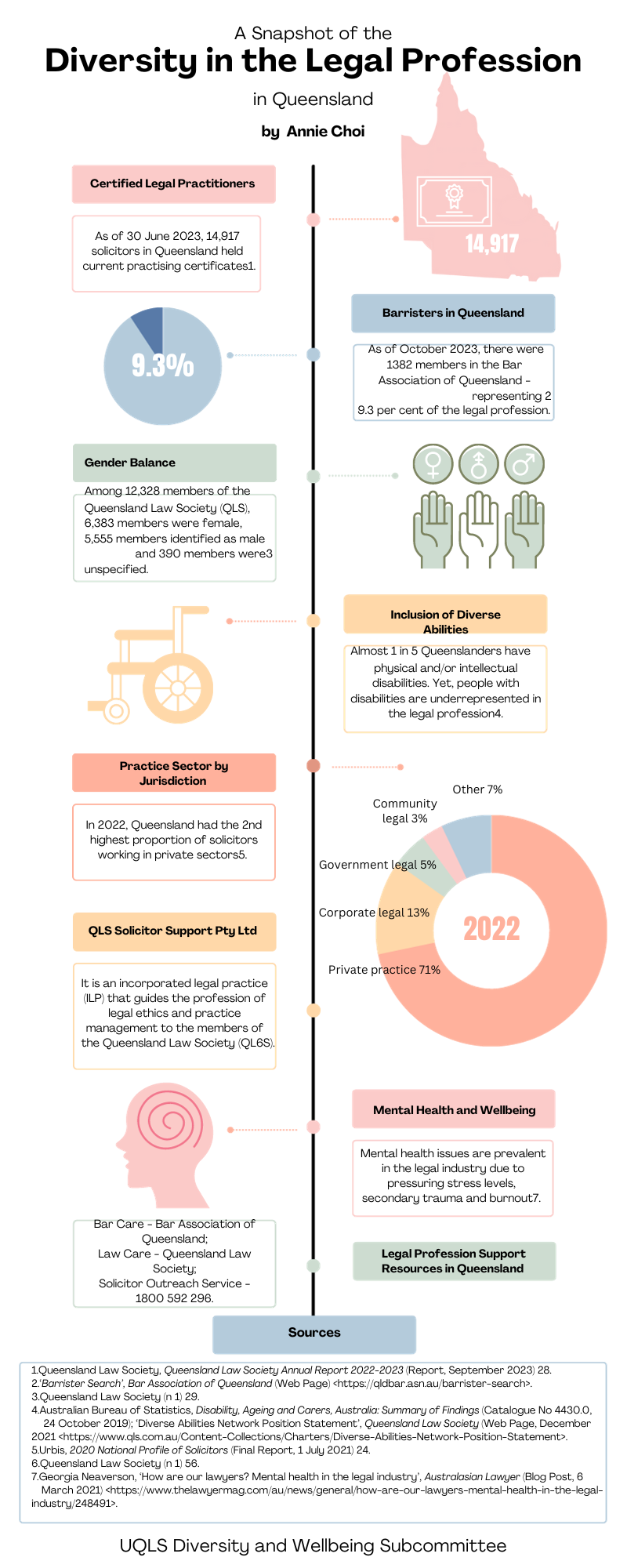
Diversity in the Legal Profession in Queensland
Written by Annie Choi
UQLS Diversity & Wellbeing Subcommittee Member

The Legal Profession as Experienced by Disabled Lawyers and How COVID-19 Has Impacted This
Written by Sherin Thomas
UQLS Diversity & Wellbeing Subcommittee Member
One in five, that is 20% of Australians have a disability however only 6% of Australian lawyers identify as having a disability. This is due to several barriers faced in the legal profession by legal practitioners who live with a disability.
It is important to note that there are several types and levels of disabilities, with each of them affecting and manifesting in individuals in different ways. Studies have revealed that only a very small percentage of legal practitioners have visible impairments, with over 90% having non- visible impairments. It is often that only those with visible impairments are declared to society and their workplaces with the majority choosing to conceal their conditions and needs.
The lack of awareness and stigma around hiring people living with a disability significantly deters employees, students, and trainees from identifying as having a disability.
Impacts of COVID-19
Living with Covid-19 over the past two years has meant that all workplaces have had to quickly make arrangements to enable working from home. This has given lawyers of diverse ability an opportunity to be more open with their needs for flexibility. “In the past [disabled lawyers] have been told it is not feasible to work flexibly, and now [they] know it absolutely is feasible” (Dale, 2021, p. 25).
The vast majority of lawyers with diverse abilities have stated that a major advantage of the change to work from home is that they can avoid the long commute into office that is often more stressful and strenuous to those with impairments. Lockdowns have also been an opportunity to demonstrate that remote working is an effective and reasonable adjustment for both the employer and employee.
However, as revealed by investigations, some professionals reported that several reasonable adjustments were requested and not provided during lockdown such as disability awareness training, flexibility and changes to targets and billable hours. One particular disadvantage of Covid-19 for many amongst the surveyed legal professionals was the difficulty in managing their mental health while working remotely. Despite the significant benefits that Covid-19 had on working arrangements for lawyers affected by disability, the consequences of risks associated with Covid-19 on pre-existing health conditions has led staff to express anxiety regarding future working arrangements which still remain greatly uncertain.
Many of those with non-visible impairments or mental health conditions that had previously refrained from identifying as disabled declared their disabilities during lockdowns for the first time. A report published by the organisation Legally Disabled suggests that this is the time to create conversations that enable people living with disabilities to feel confident to disclosing to their employer. Employers should focus on creating long-term plans in coproduction with employees who live with disability to make informed decisions on what will be most suitable. The plan should provide all employees with choices and adaptations to make work life more efficient and personalised.
Sources
Dale, A. (2021). At lunch with... The Disabled Australian Lawyers Association. LSJ: Law Society Journal, (84), 24–25. https://search.informit.org/doi/10.3316/informit.336654857129475
Foster, D., & Hirst, N. (2020). Legally disabled? The impact of Covid-19 on the employment and training of disabled lawyers in England and Wales: opportunities for job-redesign and best practice.
Stone, D. H. (2009). The disabled lawyers have arrived; have they been welcomed with open arms into the profession an empirical study of the disabled lawyers. Law and Inequality: Journal of Theory and Practice, 27(1), 93-134.
The Diversity & Wellbeing Blog is run by the UQLS as a way to keep members informed and aware of the legal profession beyond the walls of the Walter Harrison Law Library.
The main blog contributors are Diversity & Wellbeing Subcommittee members.